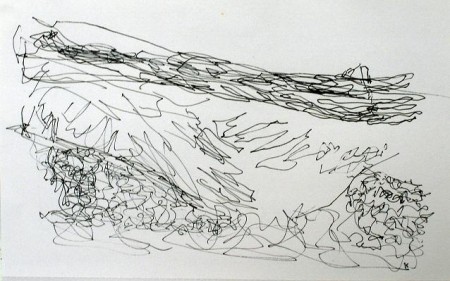
'Assynt coast line', Pen, 2009, 28 x 21 cm
As I think I’ve said in the past; when I’m painting, the door to my studio is always open. I really like the idea that people can come into the studio and see work being produced. Of course it leaves one open to all sorts of criticism and comment, but that really doesn’t bother me and indeed people often come out with some very interesting ideas.
A couple of weeks ago though, I heard a chap who’d been looking doubtfully at one of my new very simple pastel on gesso line drawings, say, “What’s this all about then”? I guess it might be a good idea to try and put down here a few of my thoughts about the drawings I do.
Drawing is for me a fundamental part of everything I work on. There are many facets to it but the most important one for me is that it is about looking and the way in which I interpret what I see. When I was fully sighted, I did a lot of observational drawing, working on still life, life drawing and outdoor subjects. I’ll be honest, I was never the greatest draughtsman but like most students at the end of their art degree, I knew one end of a pencil from another and could produce some reasonable drawings.
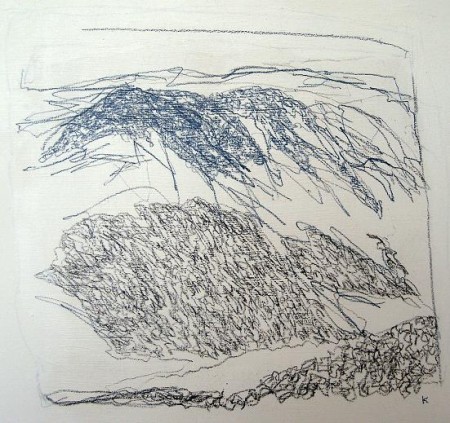
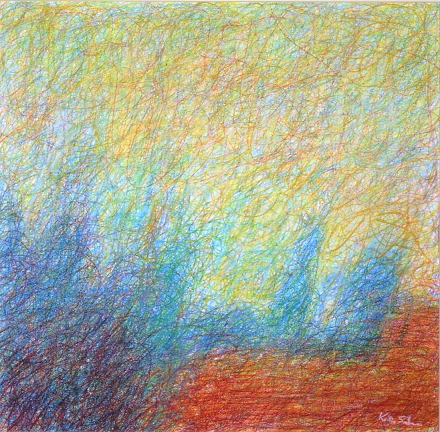
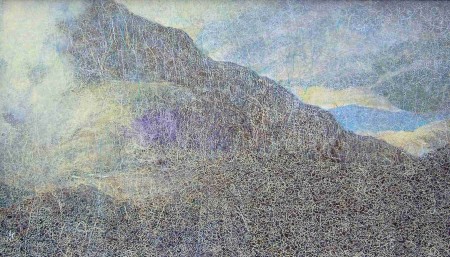
'From Conival', Pastel on gesso, 2010, 45 x 46 cm
The practise of having to look and think made drawing a very important activity for me. In doing this, one tends to look in a different way. You side-step your brain a little and instead of seeing structure as you think it ought to look (associating it with it’s name or use) you look at what it actually is, what it’s constituent parts are. This way of looking has helped me appreciate beauty in so many things. I look at everyday objects and enjoy them simply for what they are. In art, I love Carl Andre’s infamous bricks and the stunning simplicity of Richard Sera’s ‘Berlin block for Charlie Chaplin’….a huge cube of rusting forged metal.
Drawing then, helped me to look at things in a slightly different way. As my sight started to deteriorate, the view I had, became much more simplistic. After all this time trying to teach myself to look beyond the immediate detail, I suddenly found that this bothersome detail no longer existed …the world I now saw was made out of simpler rather vaguely shaped structure and space. Through the many years of drawing, I’ve become used to thinking about my surroundings in this way and so it wasn’t so difficult adapting to my new view. In a strange way, drawing has actually helped me come to terms with my visual impairment.
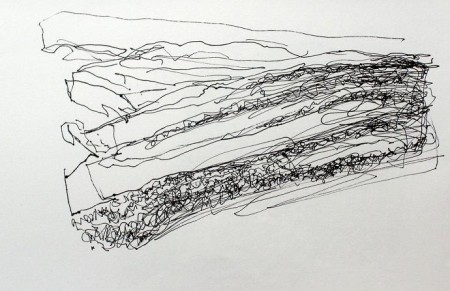
'On Rannoch Moor', Pen, 2009, 28 x 21 cm
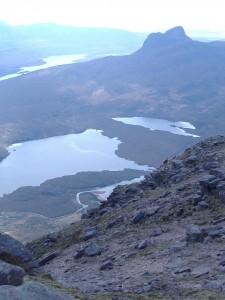
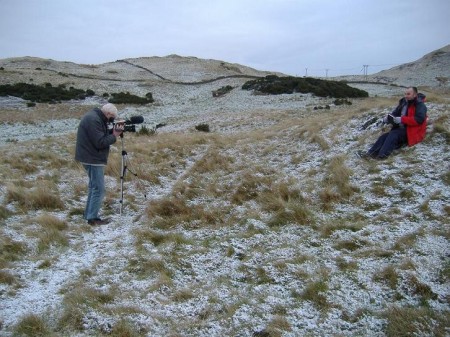
The simple line drawings I do are done for a number of reasons. When working outside using a pen, the primary purpose is to make me look at the landscape I’m in. As I said on the short video, it’s quite a bazaar process. Having just a little bit of sight in one (my right) eye, I have to hold a monocular up to this eye with my left hand and then try and sketch with my right hand …occasionally looking down to see what I’ve got. The finished sketched are rather hit and miss, but as scribbled as they are they do help me remember the scene for future reference and some of them in this rather random way are beautiful in their own right. The pastel on gesso drawings are worked from these outdoor sketches and are about my trying to create simple but beautiful compositions in line. Although I like to do these drawings for their own sake, they are also used to work out the compositions for my paintings.
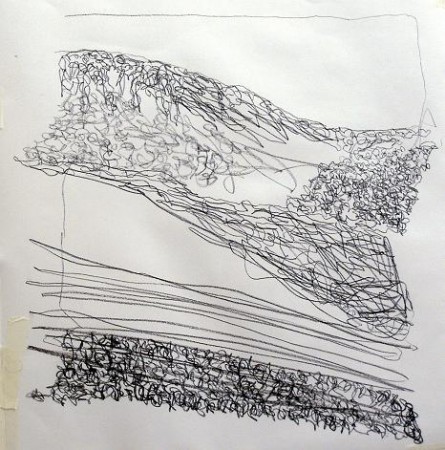
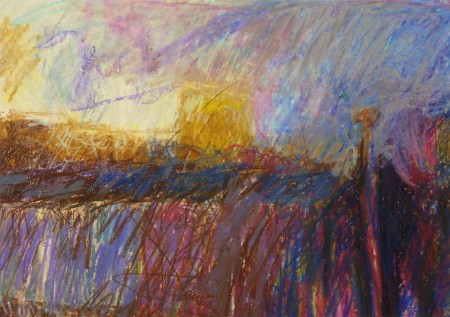
'Winter slopes, Glen Lyon', Oil pastel, 50 cm (w) x 54cm (h)
Drawing then is something that is embedded in most of what I do. It helps me see my surroundings, it has taught me to appreciate beauty in simple structure and it allows me to record these things. Above all, drawing a line has taught me about composition – possibly one of the most important things in my work.
 Posted in
  Tags:
Tags: 
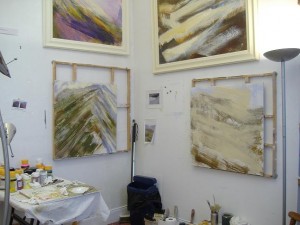 It’s been an interesting day today, partly because of the weather and partly because of the work.
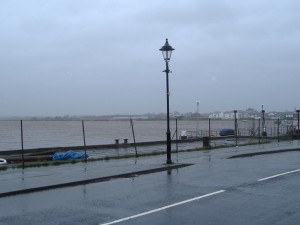 Oh yer, the weather. It poured all day …and is still pouring. From my studio door I could watch the high tide racing in and completely covering the saltings opposite. It was a wonderful spectacle,. An interesting place to work …in very interesting times.
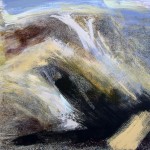 On Friday 23rd October my partner Anita and I drove across to Edinburgh in order to hand in the two paintings I was entering for the RSA Annual Exhibition.
 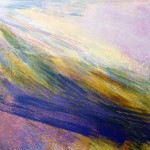 Thankfully it was a beautiful day with bright sun and it was nice just to stand and look at these fantastic buildings. It was also quite fun listening to some of my fellow ‘failed to get selected’ artists moaning and complaining about the long wait! It took about an hour and a half to get to the front of the queue and I felt rather sorry for the people working there, the woman who helped us find my paintings said she hadn’t had a minutes break since 10 o’clock and she looked in desperate need for a cup of tea. There were still many many works to be handed back so it looked like it was going to be a long day for them all, but somehow they were all still smiling and doing a great job. We eventually got back to the studio at around 5pm …both feeling a little shattered. All that effort not to get the work into the show. But that really is the nature of the beast. If you enter these large competition exhibitions the odds are well stacked against you. You know there will probably be several thousand other hopefuls entering too and that your work will be viewed for just a matter of seconds in the selection process.
 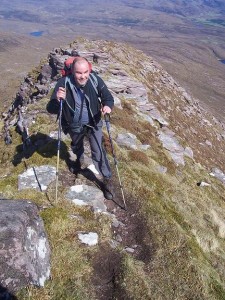 I took the decision back in 1990, when my sight first started to deteriorate, to carry on hill walking come what may. Initially I bought myself a traditional walking stick in the hope that it would give me support as well as tell me a little of what the ground in front of me was doing. My partner Anita took on the job of guide. Well we found we could still walk on the hill like this albeit very slowly, but I really wasn’t sure about the sense of what I was doing and really wasn’t very confident.