counter hit xanga
February, 2010 | Scottish Landscape Art - Scottish Landscape Paintings

Archive for February, 2010

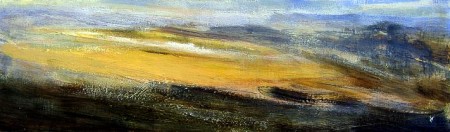
Work of the Week: ‘ Ben Ledi from Benvane, April afternoon’

'Ben Ledi from Benvane, April afternoon', Acrylic & Pastel, 2009, 76 x 23 cm Ref:106

'Ben Ledi from Benvane, April afternoon'

‘ Ben Ledi from Benvane, April afternoon’ , Acrylic & Pastel, 2009, 76 x 23 cm

It’s amazing how fast this last year has gone and despite the current snow and cold, spring really isn’t far around the corner. Last April we spent a long and tiring day walking the two hills of Ben Ledi and Benvane. There was still a few patches of snow high up but the day itself was clear and warm with bright sunshine and little if no cloud. The walk up Ben Ledi is by a big path and attracts a lot of walkers. Once down the other side and past the descent path, the long undulating ridge over to Benvane is far less frequented. We only met a couple of other walkers on the long haul over and by the time we reached the summit of Benvane in the mid afternoon, we had the place to ourselves. Big views indeed and brilliant colours. At this time of year though the days still aren’t that long and we had a very long trop back. We made it off the hill before dark but didn’t miss the thundery shower waiting to soak us a mile from the car!

A working walk

Arran: Scottish Mountain: Cir Mhor

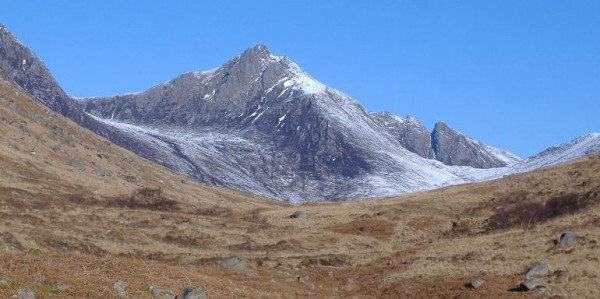
Cir Mhor from Glen Rosa

Well, as I said in a brief comment on Face book earlier this week, I finally got a day, if not on the hill, then certainly in amongst them. We’ve been having a lot of fine cold clear days recently and last Friday we decided to take a trip over to the Isle of Arran.

From Irvine, Arran is just a few miles away across the Firth of Clyde. Indeed, even with my poor bit of sight, with the aid of a monocular I can see the mountains at the north end of the island from my studio door. To actually get there, takes a short trip up the coast to Ardrossan where the ferry to Brodick goes from. Until a couple of years ago, it wasn’t really possible to do a serious walk on Arran in a day trip during the winter months. The winter ferry service was somewhat restricted and for me at least, there wasn’t enough time between first and last ferry. Now though, there is an early ferry leaving at 7.00am and, and a later ferry back from Brodick.

Arran: Scottish Mountains: Glen Rosa

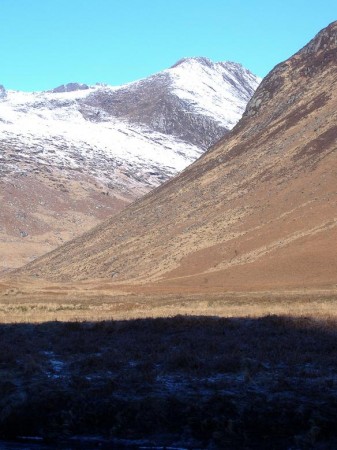
Glen Rosa, Isle of Arran

So then, with the temperature at -4C and the first light just appearing, we went on board and went straight to the café ..you can get an excellent breakfast on board and it sets you up nicely for the day ahead. It takes about 55 minutes to get across to Brodick and by the time we walked down the gangway the sun was lighting up the tops of Goatfell and it’s neighbours …all of which were covered with snow. It looked stunning. We hadn’t at this stage decided quite what we were going to do and had carried all our winter gear incase we decided to head uphill. The scenary and colours were so good that we decided to make this a working walk and to simply take a wander the few miles up Glen Rosa in the heart of the Arran hills. With the wonderful mixture of snow, crags, grass and bracken, there would be plenty of scope for photographs and sketching.

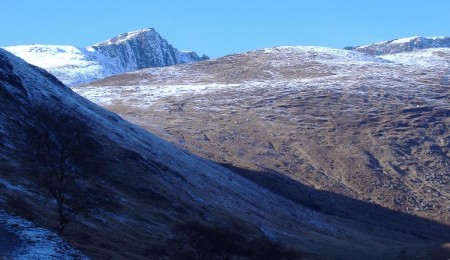
The walk along the front and around the edge of the golf course at Brodick is scenic enough in these conditions but as we approached Glen Rosa it was just spectacular. On the north facing slopes the snow was all the way down to the base of the glen, on the southern slopes the lower levels were free of snow and the grass and bracken was a mixture of bright ochres, yellows and terracotta in the low early morning sun light.

Arran: Scottish Mountains: Glen Rosa, Isle of Arran

Glen Rosa, Isle of Arran

After about a mile the glen takes a sharp dogleg to the right and you can see all the way up the glen to Cir Mhor – a wonderful pointy peak at the head of the glen that incidentally, is as pointy at the tip as it looks …but that’s another tale. At this point we were out of the shade and into bright sun and so it seemed a good point to do some sketching and just enjoy our surroundings. Then disaster ….I thought I’d packed my sketchbook and drawing pen …well, I’d got the sketchbook, but the pen I’d picked up was not a drawing pen ..it was a thicker indelible marker pen! Oooops. That’s the joy of fuzzy sight for you! Oh well, nothing for it, I’d just have to draw with this …but it wasn’t very successful and although that day I did three drawings – all of them were dreadful. What do they say about bad workmen always blaming their tools?

Despite this, it was a great day and a very useful one for me. I came away with several new ideas for paintings and although the drawings weren’t great, just sitting and looking at the hills and glen with my monocular really helps when it comes to painting later.

Work of the Week: ‘Winter afternoon, Beinn Dorain’

137 'Winter afternoon, Beinn Dorain', Acrylic & Pastel, 2009, 90 x 60 cm

'Winter afternoon, Beinn Dorain'

‘Winter afternoon, Beinn Dorain’, Acrylic & Pastel, 2009, 90 x 60cm

I did this painting after a fantastic day walking this time last year.  A friend and I went up to Bridge of Orchy to climb Beinn Dorain – and caught ourselves a wonderful few hours of weather.  It was freezing hard all the way up from the road, but there really wasn’t much snow except on the steep north facing slope not far below the cairns.  As we climbed the clouds broke and although clear around us, the hills of Crianlarich and Glen Falloch were all sticking there heads out of the mist.  Being mid week we only saw a couple of other walkers and when we reached the main summit we had the place to ourselves.  We just sat and took in the incredible views and complete silence.

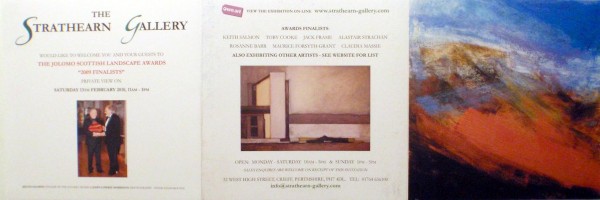
The Jolomo Scottish Landscape Awards – ‘2009 Finalists’ – Strathearn Gallery, Crieff

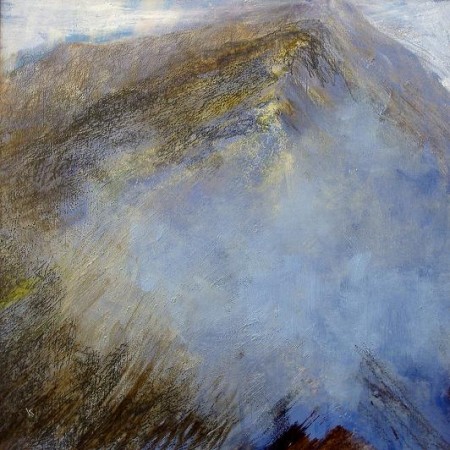
144 'Breaking cloud, Am Bodach', Acyrlic & Pastel, 2010, 80 x 80 cm

'Breaking cloud, Am Bodach'

Well, the exhibition opened last Saturday and the eight paintings I included in the show were finally completed, framed, delivered and hanging on the walls in time for the opening at 11.00am that morning!  Now, that doesn’t sound difficult does it?  Just eight pieces.

Of course, I couldn’t do it the easy way and select eight already completed pieces.  No, I was determined to do a few completely new paintings for this show.  And, bar for a few days of panic while I was trying to finish the ‘Winter, Blackmount’ painting … (I just couldn’t get it right for a while), everything went ok.

The framing though was another matter.  The five smaller paintings were fine.  These are always framed the same way; behind glass with a wide single mount and a stylish but simple 7 cm wide distressed ‘York’ silver frame.  This seems to work well with the scratchy, scribbled nature of my paintings.  The three larger pieces were another thing entirely.  At this scale (80 x 80 cm and 60 x 60 cm) I needed a different kind of frame; something without a mount and glass.  I tried a lot of different mouldings and colour combinations before hitting on the right thing.

It’s a fairly broad simple wooden frame with a raised outer edge, painted a pale cream colour and with a thin gold inner edge.  This seems to work well with these paintings.  This sounds quite simple but getting to this point took much bashing of my head against the wall as to start with I’d decided the frames should be dark and with a second outer edge of gold.  This made them look like window frames and so they all had to be completely re-painted ….ooops!  Oh well, we got there in the end and as my framer said …the customer is always right …but not always correct.  He may have a point

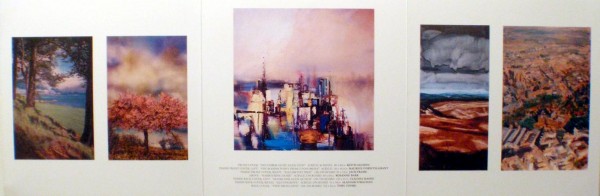
The show, containing work by the seven of us short listed for last years Jolomo Awards for Scottish Landscape Painting, looks good.  It’s a smashing gallery with large well lit spaces on two levels.  It was great meeting up with the others again and seeing what they’d all been doing.  There’s a lot of very fine work there, so if you can get to Crieff before the show ends on March 20th, then I’d recommend it …not that I’m at all biased of course!  Of all the work though, my fuzzy eye was caught by Toby Cooke’s fantastic painting, ‘View from Leith’.  It’s quite big and the composition is just great.  Anyway, you can see for yourself, even if you don’t live in driving distance of Crieff …the show can be seen on-line:  www.strathearn-gallery.com .

At the end of the preview on Saturday I was feeling pretty happy as I’d sold a few of my paintings and the gallery has asked if I’d like to put on a solo show in 2011 …Wow!  Mind you it’ll be a lot of work – something in the region of forty pieces, so it’s a good job I’ve a year to work on it!

Jolomo 2009 Finalists Catalogue

Work of the Week: ‘Suilven, from the coast’

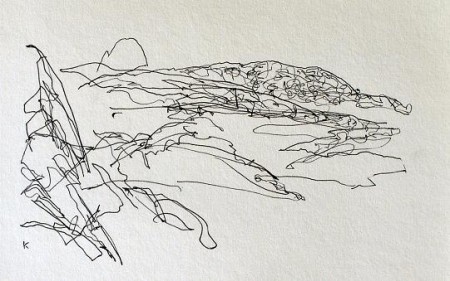
‘Suilven, from the coast’, Pen, 2009, 18 x 12.5 cm

'Suilven from the coast', Pen, 2009

‘Suilven, from the coast’, Pen, 2009, 18 x 12.5 cm

I’ve always loved sketching outside although it’s sometime difficult to make yourself stop and draw when you’re out on the hill walking. But it really is worth while as it gives you a chance to really take in your surroundings. I did this little drawing last year when Anita and I were on holiday last May in Assynt. We were staying at the beautiful sandy bay of Achmelvich, just a few miles up the coast from Lochinver, and, as the weather was too poor for a day on the hill, we decided to follow the craggy coast south for a couple of miles. From any where along this coast the famous Assynt sky line grabs your attention – if of course the cloud is high. On this day, despite the gales, the famous Assynt peaks of Canisp and Suilven were clear and, at a sheltered spot I decided to sit for a short while and do some drawing. This quick little sketch was the result.


Help Required

Last week I was contacted by Jean and Hilary, the two former owners of the successful Gallimaufry Gallery in Blairmore, near Dunoon.  They explained that they were organising a sale of artwork in Oban, in order to raise funds for the relief effort in Haiti, following the recent devastating earthquake there.  They asked if I would be interested in taking part and if I could let them have a piece of work for the sale.  This is a great opportunity to support those who do the real work and so the only question for me was which painting to donate for the sale.  I wanted something that was quite bright, something that would hopefully catch the eye and in the end decided on a painting that has developed over a number of years. 
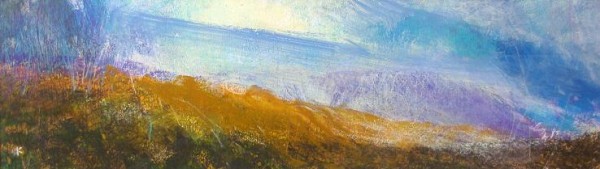
 

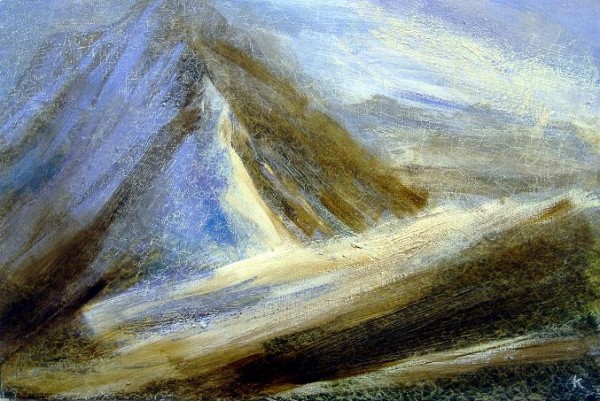
'Below Ben Oss, winter', Acrylic & Pastel, 2006 - 9, 76 x 23 cm

'Below Ben Oss, winter'

Interestingly I originally did this painting for a show organised by Jean and Hilary at Gallimaufry a number of years ago.  I’ve had the painting in my studio ever since and have always like the colours but as time has gone by and my work has developed, I’ve felt I could improve it.  I’ve never really been one for that ‘don’t go back to a painting once it’s finished’ malarkey and so a few months ago I decided to‘re-work’ it.  As I’ve said in previous blogs, my work is very gradually erring more towards the abstract and is certainly more painterly.  I’ve been using broad sweeps of paint in many of the more recent works and this is how I’ve‘re-worked’ this painting.  The basic underlying structure is still there, but a new semi translucent diagonal sweep of blue / purple, has completely changed the composition.  I am very pleased with this new version and hope someone at the Oban sale will like it too.


The work will be part of the sale which will take place on:

SATURDAY 27TH FEBRUARY AT THE REGENT HOTEL IN OBAN – FROM 2.00 – 7.00PM


Many artists will be taking part, so if you can get along your support will be much appreciated.  Full details of the event below.  If you are an artist yourself and would like to take part in the sale, please contact the organiser Jean Thompson by email:  jean_thompson47@yahoo.co.uk


Help for Haiti

To raise much needed funds to relieve the suffering of people in the devastated island of Haiti, an Art Sale will be held on Saturday 27th Feb. in the Regent Hotel, Oban from 2.00-7.00pm. Many Scottish artists will take part to make a truly eclectic collection of works.

Among those is Elizabeth Bruce, a Scottish contemporary artist whose painting style is representational but not photorealist. She has worked in all media on a variety of subjects, usually concentrating on acrylics – still life, treescapes, figures, interiors and landscapes. In January 2003 she was elected a member of the Glasgow Society of Women Artists. Her work has been shown in various galleries in Argyll, as well as the RGI Kelly Gallery and the Lillie Gallery, both in Glasgow, and the Torrance Gallery in Edinburgh. Elizabeth likes to keep her work within the Affordable Art bracket and prices start as low as £25 for an unframed lino-cut, while paintings are all between £140 and £500.

Sue Challis has lived and worked on the West Coast of Scotland for over twenty years. Educated in North London, she qualified as a lecturer in craft and design and youth leadership.   She now concentrates on acrylic painting and pen & ink drawing. When she is not painting, Sue and her husband run the Raven Trust sending containers of aid, medical, educational and small business start-up equipment to Malawi. Sue loves the bright colours and dancing light of the North West Coast of Scotland and this is passionately evoked in her work.

Aiming to be there in person is award winning artist, Keith Salmon. Keith combines his twin passions of hill walking and landscape painting in his work. What makes him truly remarkable, though, is that he lost much of his sight almost 20 years ago. Despite these “difficulties”, his work won the Jolomo Award for Scottish Landscape Painting in 2009. Describing some of his visits with partner Anita to some wild and remote glens and summits, under all conditions throughout all four seasons, Keith says “Even with my fuzzy vision this is a truly wonderful and stunning landscape. In my paintings I try to capture something of these incredible places, something of their sheer scale, complexity and beauty.”

This sale of art is being organised by 2 former gallery owners who will donate all profits to Mary’s Meals for their ongoing work in Haiti. Many of the artists are donating the full sale price of their works to the appeal. One such is Calum MacFarlane-Barrow whose son Magnus runs this international movement from Dalmally. The following news update comes from their web page.

“Mary’s Meals has been working in Haiti since 2006 providing meals for over 12 000 children in schools in Cite Soleil, Gonaives and Hinche.    We now know that our seven schools in Cite Soleil have been damaged, but not destroyed. We will be working to help repair and rebuild these schools, to support their pupils and to assist with the wider recovery in the capital in any way we can.

In the city of Hinche, we have started to provide food and medical supplies for earthquake victims and their families who have arrived looking for food and treatment. Many have nothing but the clothes on their backs and these regional hospitals are now over-flowing as well. When local stocks run out, as we expect them to soon, we will make arrangements for aid to be brought in from the Dominican Republic.

It is becoming clear that the recovery effort in Haiti will need to be long term and widespread. Anything at all that you can give to help us will be appreciated.”

Please come along to this event to help this cause and maybe pick up a prized original art work. Prices will suit all pockets from £1 art cards to the much bigger paintings.

Work of the Week: Organised Scribbles

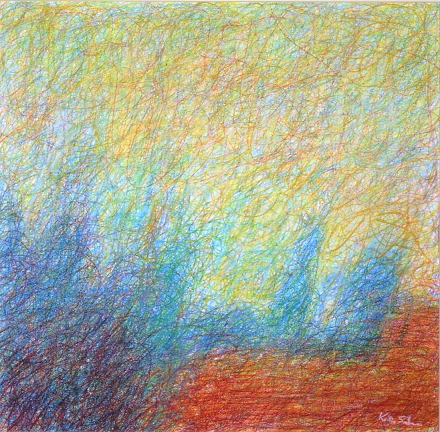
1.7 'Early Morning', Pastel, 2003, 45 x 45cm

'Early Morning'

‘This was the first of my ‘organised scribbles’. I drew this after a particularly beautiful early morning walk through the countryside near Irvine. The low early sun was so bright that I could see very little, just the vague shapes of odd trees and shrubs amidst the summer grasses’.

This drawing was created using hard, water soluble pastels. The drawing is built up in layers of scribbled pastel line, starting with very light and pale colours and gradually developing the drawing using brighter and darker ones. Putting down the first few layers is a pretty soul destroying and time consuming task and one which I’m always grateful for having one of the RNIB talking book machines and a good book to listen too! Once through this stage, the interesting part starts, I can work out what’s happening and where I’m going with the drawing. For me, the great thing about working in this fashion was that I’d found a way of working that didn’t need much sight but that still had the appearance of being quite detailed.

These early drawings were nearly all based on the local Irvine landscape and townscape. The harbourside where my studio is situated is a wonderful place, changing in mood from hour to hour as the tides ebb and flow and the weather moves in off the Firth of Clyde. The light, just like in the hills, is constantly changing but it’ never dull …even on the dullest of days. It can be equally stunning on a day of gales and rain as on a beautiful summer’s day. It was then for a while the focus of many of my new drawings.

The art of organising scribble

1.7 'Early Morning', Pastel, 2003, 45 x 45cm

'Early Morning' - 2003

The realisation that I could still scribble was a huge turning point for me in the lengthy period of readjustment and re-learning I was doing after my sight started to deteriorate around 20 years ago.  I had always loved drawing and see it as one of the fundamental basics behind all my artwork.   Before the fuzzy eyes arrived my drawings varied enormously, from quite tight observational drawings usually of or planning for the sculpture I was then making, to loose and simple sketches done outside and more considered studio based pieces using a lot of colour.  All of them though were dealing with one main issue, that of composition.

I can’t honestly say that I made the jump to scribble and more importantly organising scribble in a sudden moment of inspiration.  I don’t think things really work like that.  I can’t remember quite how the transition took place but I do know and remember distinctly doing the drawing ‘Early morning’ and realising immediately that I’d just gone a long way to confounding the visual impairment with regards to my efforts to continue creating half decent bits of art work again…

‘This was the first of my ‘organised scribbles’. I drew this after a particularly beautiful early morning walk through the countryside near Irvine. The low early sun was so bright that I could see very little, just the vague shapes of odd trees and shrubs amidst the summer grasses’.

This drawing was created using hard, water soluble pastels.  The drawing is built up in layers of scribbled pastel line, starting with very light and pale colours and gradually developing the drawing using brighter and darker ones.  Putting down the first few layers is a pretty soul destroying and time consuming task and one which I’m always grateful for having one of the RNIB talking book machines and a good book to listen too!  Once through this stage, the interesting part starts, I can work out what’s happening and where I’m going with the drawing.  For me, the great thing about working in this fashion was that I’d found a way of working that didn’t need much sight but that still had the appearance of being quite detailed.

1.8  'Riverside, evening', pastel,

'Riverside, evening'

These early drawings were nearly all based on the local Irvine landscape and townscape.  The harbourside where my studio is situated is a wonderful place, changing in mood from hour to hour as the tides ebb and flow and the weather moves in off the Firth of Clyde.  The light, just like in the hills, is constantly changing but it’ never dull …even on the dullest of days.  It can be equally stunning on a day of gales and rain as on a beautiful summer’s day.  It was then for a while the focus of many of my new drawings.

On The Hills

Of course by this stage I was walking the hills regularly and I started to turn my attention towards using these trips as the source for my work.  At the time I couldn’t really figure out a way of doing paintings about these wild places.  My early efforts were pretty dire to say the least.  I was trying to paint them in a more traditional manner and had to use magnifiers to have some idea of what I was doing.  This was a frustrating time for me as I realised that the hills were what I wanted to paint, but I just didn’t know how to go about it.  The early attempts were trying to paint something that I didn’t actually see.  Then I figured out that I needed to try and paint the fuzzy patterns and atmosphere as I now experienced the landscape..and what better way then to use my scribbled line to create this.  So then, I started to scribble onto these paintings, creating a fine of veil on the surface of the paintings.

'From the slopes of Sgorr nam Fiannaidh, Glen Coe', Oil & Pastel, 2004 - 2006, 85 x 49cm, Ref: 22

'From the slopes of Sgorr nam Fiannaidh, Glen Coe' 2004-2006

One of the first of these pieces was a largish painting that tried to capture the brief moment as the cloud broke while we were descending the upper slopes of Sgorr nam Fiannnaidh above Glencoe and Loch Leven.  It wasn’t the complete answer but it did produce a painting that was much more about my experience of being in the hills.  There was and still is, much to do in developing my ways of working, but the organised scribble and its move onto the paint surface was the starting point for much of the work I now do.